
In Collaboration with Steph Wu & Yifan Zhao

Autonomous Technology for Life Assistance and Safety

Set in a speculative 2050 future, this project reimagines how search and rescue (S&R) operations could evolve in response to increasing seismic risks. Grounded in today's S&R systems and informed by projections of future earthquake activity, ATLAS envisions how emerging technologies might enable responders to locate survivors faster, coordinate more effectively, and make critical decisions in the aftermath of large-scale disasters.
Skills
Speculative Design & Future Foresight, Research & Synthesis, strategic design, Service Design, Information Architecture, Data Visualization, Designing, UI/UX, systems thinking
How might design improve human lives?
Our project began with this simple question:
Ideation
Rather than starting with a predetermined problem, we explored a wide range of societal challenges through research and visual mapping, identifying opportunities where design could have the greatest impact.
As our exploration evolved, we became increasingly interested in extreme environments where thoughtful design can directly influence survival, resilience, and recovery. We studied existing products used in harsh conditions and gradually narrowed our focus to search and rescue operations.
We examined a variety of disaster scenarios, including avalanches, landslides, floods, wildfires, and earthquakes, asking how technology could better support first responders in locating and rescuing survivors


To identify the most impactful disaster scenario for this project, I compiled and analyzed a time-series dataset (1990–2025) of global natural disaster fatalities using data from Our World in Data. The analysis revealed that earthquakes and floods consistently account for a significant share of disaster-related deaths worldwide. Although annual fatalities fluctuate, major earthquake events are responsible for some of the largest spikes in mortality. As global urbanization continues to increase, earthquakes present an even greater threat due to the heightened risk of building collapses in densely populated cities.
Based on these findings, earthquakes were selected as the project's primary focus. They create some of the most complex and hazardous search and rescue environments, where collapsed infrastructure, unstable debris, aftershocks, and limited situational awareness place both survivors and first responders at significant risk. Looking ahead to 2050, the continued growth of urban populations will make technologies that improve responder safety, enhance coordination, and accelerate survivor detection increasingly essential.
Further research into future seismic activity reinforced the importance of this challenge:
-
Approximately 16 major earthquakes (magnitude 7.0+) are expected worldwide each year.
-
More than 2 billion people in developing nations could be exposed to significant earthquake risk.
-
The possibility of magnitude 9.0+ earthquakes remains a serious concern.
-
Climate change may further increase seismic hazards and the vulnerability of affected communities.
-
These insights established the foundation for ATLAS, a speculative search and rescue system, designed to support emergency responders in the increasingly complex disaster environments of the future.
We conducted a SWOT analysis to identify opportunities during S&R missions. We identified that the biggest opportunities for improvement included creating a unified data and communication system, lowering risks for rescuers, and predictive modeling of structural collapse. We then looked at current S&R operation items, and saw where we can position our product through doing market research. Lastly, we identified who our stakeholders will be and how they will benefit from our product/


Save lives during earthquakes with fast data-driven S&R, helping responders locate survivors, confirm signs of life, and choose safe extraction paths while protecting team safety.
Through the research, our mission statement became
Current System
Current search and rescue systems generate valuable data, but it is often fragmented and only accessible through the command center. This creates communication bottlenecks, slows information sharing, and delays critical decisions in the field.

A.T.L.A.S. System
A.T.L.A.S. provides a unified, shared data system that gives all authorized stakeholders real-time access to the same information. Rescue teams can instantly view scanned building layouts, structural collapse conditions, victim locations, and signs of life without waiting for updates from the command center. This enables faster local decision making, improves coordination, and reduces delays during rescue operations.


A.T.L.A.S. UI / UX
To demonstrate the user experience, the interface is presented through two user stories that showcase how key stakeholders interact with the system throughout a search and rescue mission.

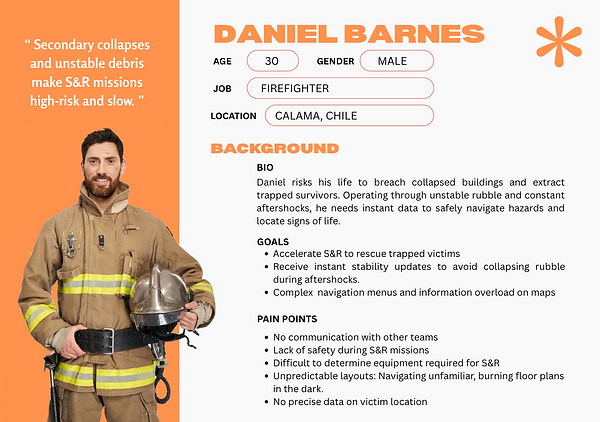
The frontline dashboard presents only the most essential information through a clean, uncluttered interface. Designed for firefighters operating in high-pressure, time-critical environments, the UI prioritizes clarity, readability, and speed over complexity. By minimizing cognitive load and reducing unnecessary interactions, responders can quickly interpret critical information, make informed decisions, and maintain their focus on the rescue mission rather than navigating the interface.


